
FDA and Improved Transparency

When the FDA rejects a new drug application, it sends a so-called “complete response letter” or CRL to the company that applied for the drug approval. The CRL will have details on why the FDA rejected the application, which will often be something like, “The company didn’t do a rigorous randomized trial” or “the study measured an endpoint that doesn’t matter for the condition in question.”
Back in 2024, I published a policy brief with the Institute for Progress arguing that the FDA has been wrong for treating these letters as completely confidential—in fact, while the letters might refer to occasional proprietary information from the company, the rest of these letters is immensely valuable information about how the FDA is making decisions.
Thus, these letters should presumptively be public (with anything truly confidential being redacted). I sent the policy brief to someone I first met over 10 years ago (Marty Makary, then the incoming FDA Commissioner), who seemed appreciative.
Lo and behold, in September 2025, the FDA started releasing these letters publicly. And a lot of companies weren’t too happy.
As discussed in a great piece by my friend Adam Kroetsch, a company hired a top DC law firm (Covington & Burling) to file a petition with FDA making the case that releasing these letters is illegal. Adam’s piece is worth reading, and I just wanted to add one point:
Covington’s petition lists several examples of the FDA releasing information that was supposedly “confidential.” All of the examples make no sense.
OK, that is pretty harsh for the normally serene and academic Good Science Project newsletter.
Let’s take one example.
Covington’s memo (page 6) points to a complete response letter issued to Stealth BioTherapeutics for a drug called elamipretide, which is for a very rare genetic disorder called Barth Syndrome. The FDA initially denied approval for this drug, along with a 10-page CRL that is now public, although it soon thereafter granted accelerated approval.
Why does anyone think the letter to Stealth was somehow leaking confidential information to the public?
Here are the only examples that Covington lists about confidential information in Stealth’s CRL:
For example, FDA emphasized the p values seen in the sponsor’s randomized, placebo-controlled study and raised concerns related to study endpoints. FDA cited “significant limitations” with respect to the sponsor’s externally controlled study, including “concerns with selection bias and comparability of the control to the treated arm” and “issues with the propensity score methodology.”
I’m a former lawyer myself, so I have some sympathy for the folks trying their best to make a case here, but as a PhD-researcher who works on public policy, it seems quite odd to suggest that a company’s confidential information has been released if the FDA is worried about p-values and about the validity of a propensity-score study to eliminate selection bias.
Not only are those issues are core to several decades of scholarly discussion about how to do rigorous studies, in this case they are core to the decision-making process of a government agency that regulates about 20% of the American economy! The entire public has a right to know that these standards are being upheld.
As for the reference to p-values, here is the FDA’s paragraph that is apparently of such concern:
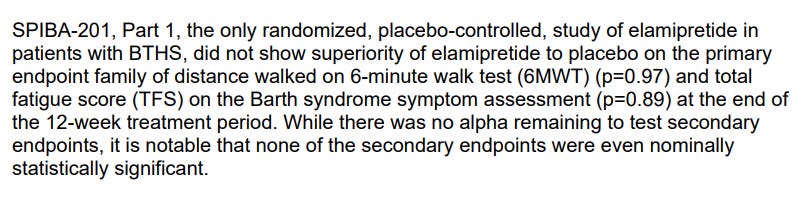
I do not think it should be news to anyone that p-values of 0.97 and 0.89 are NOT signs of success in a clinical trial. Literally anyone who has ever taken basic statistics should know that. Covington is saying that one specific company has a proprietary interest in the idea that such p-values are a sign that the trial failed.
Here’s the other part of the FDA’s letter that Covington seems to single out as objectionable:
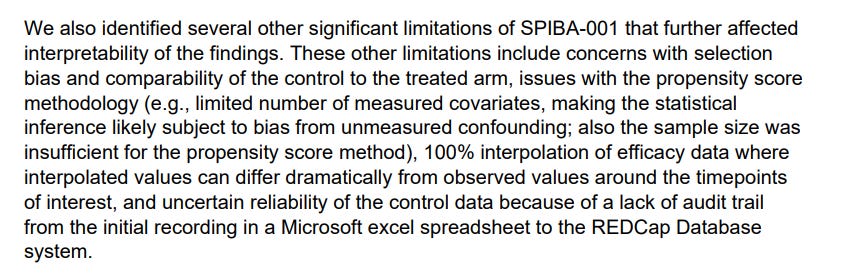
Issues like selection bias, sample size, and limited covariates are all completely standard issues to worry about in any statistical analysis of any issue whatsoever (from drugs to economics to psychology). The idea that one American company has a proprietary right to keep anyone else from knowing that the FDA cares about routine statistical issues? Odd.
I could go through the other examples, but that would be tedious. They all were about routine statistical or medical issues that have absolutely nothing to do with any company’s proprietary discovery, but are instead about issues like “does this biomarker actually work” or “is a p-value of 0.97 a sign of success.”
Covington’s memo says that these issues are still confidential because saying them publicly provides a “roadmap to competitors on how to achieve FDA approval without their needing to invest in the trial and error that is a necessary part of the innovation process.”
There is no need for every applicant to the FDA to “invest in the trial and error” of proposing bad statistical analyses and bad biomarkers.
Doing so is wildly inefficient for the whole drug discovery process! It would be far better for everyone if the FDA’s basic standards as to statistics and biomarkers were publicly known far in advance of conducting clinical trials and analyzing the data.
Part of the problem here is that the FDA often or mostly acts through specific decisions or through guidance documents, rather than through official regulations that everyone knows about in advance. Apparently that has created the impression amongst many industry participants that they have some proprietary right to keep everyone else from knowing how the FDA makes decisions.
That is not how to think about such a significant government agency. The FDA’s decision-making process should be as transparent as possible so that everyone else in the industry knows how best to design clinical trials, and what endpoints to use, and so forth. These are all standard statistical and medical issues, not anything that one company has the right to keep a secret.
One more thing: Before FDA Advisory Committees have their regular meetings, they post all of the documents to be discussed. For the example above (Stealth), the FDA had already posted over 200 pages of detailed information about the drug and its effects, etc. See here and here. No one has said why a short 10-page letter from the FDA would have more confidential or proprietary information than was already publicly available.
The FDA should reject Covington’s petition. And ironically, Covington’s own client would likely be better off in the long run by being able to see how the FDA makes decisions in so many other cases.
The Covington examples here are rightly called out as weak i.e. p-values and propensity score concerns are textbook statistics, not trade secrets. But the "roadmap" argument deserves more scrutiny in edge cases: imagine a first-in-class therapy targeting a novel mechanism where the FDA's feedback on a specific biomarker selection reflects genuine scientific uncertainty that hasn't yet entered the public literature. In that scenario, a competitor could plausibly free-ride on the pioneering company's costly trial-and-error without having to do the underlying work. The fix probably isn't confidentiality by default, but a more granular redaction standard that distinguishes routine statistical critique from feedback that reveals genuinely novel scientific judgment calls.
This is the right hill to die on. I think the harshness is earned (though I don't know if it will be effective). What strikes me about Covington's "roadmap to competitors" argument is that it quietly reclassifies a public good as a private asset. The FDA's standard for what counts as a valid endpoint, or whether a propensity-score model survives contact with selection bias, isn't proprietary science; it's infrastructure. A standard everyone can see is a road; a standard only the incumbent can see is a toll booth. The petition is really a request to keep the toll booth.
There's a lot of irony in the fact that the confidentiality claim is only plausible because the FDA mostly governs through case-by-case decisions rather than published rules. The opacity is what manufactures the proprietary feeling. Release enough CRLs and the "secret" evaporates—not because anyone leaked anything, but because the de facto rules finally become legible. That's not a loss to the applicant; it's the difference between an agency that recites its obscure standards and one that publishes them. As you say, even Covington's own client comes out ahead in a world where it can read everyone else's letters.